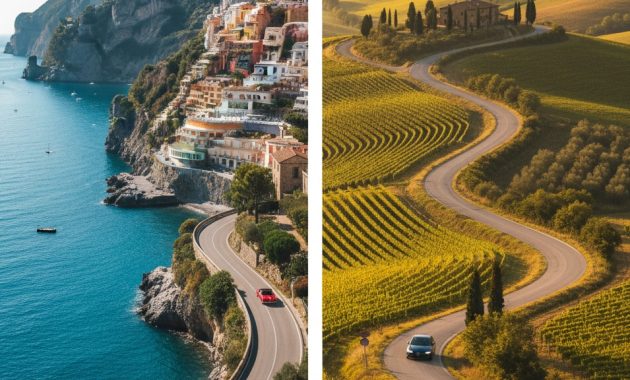
There’s something timeless about driving through Italy — windows down, sunlight spilling over ancient villages, and the smell of espresso drifting from roadside cafés. The country’s diverse landscapes make it a paradise for road trippers: one day you’re cruising along a dramatic coastline, and the next, winding through vineyards and medieval towns. This Italian Road Trip Guide takes you beyond the tourist trail — into olive groves, seaside villages, and the kind of countryside that feels lifted from a painting. Whether you crave adventure or quiet discovery, Italy’s roads promise both.
Why Take a Road Trip in Italy?
Italy is more than just its famous cities — it’s a country of hidden corners and rural charms best explored on your own schedule. A road trip gives you:
- Freedom and Flexibility: Stop wherever catches your eye — from a roadside vineyard to a local trattoria.
- Scenic Diversity: Drive from snow-capped Alps to sun-soaked beaches in a single journey.
- Authentic Experiences: Meet locals in small towns untouched by mass tourism.
- Cultural Richness: Each region offers its own food, dialect, and traditions — best discovered at your own pace.
Imagine tracing the Amalfi cliffs, cruising through Tuscany’s golden fields, or circling Lake Como’s shimmering shores — Italy invites you to slow down and savor every moment.
Coastal Drives: Sun, Sea, and Spectacular Views
1. Amalfi Coast Drive (Campania)
Route: Sorrento → Positano → Amalfi → Ravello
This world-famous stretch between Sorrento and Amalfi is both thrilling and breathtaking. The road clings to cliffs, curving above turquoise waters with views that’ll stop you mid-sentence. Pull over at scenic viewpoints, taste limoncello in Positano, and end your day with a sunset dinner overlooking Ravello.
Highlights:
- Positano’s pastel houses
- Amalfi’s cathedral square
- Ravello’s romantic gardens
Tip: Drive early morning or off-season (May or September) to avoid traffic and enjoy calmer roads.
2. Cinque Terre Coastal Road (Liguria)
Route: La Spezia → Manarola → Vernazza → Monterosso al Mare
Though Cinque Terre is best explored by train or on foot, driving the coastal road rewards you with panoramic sea views and quiet villages above the main towns. Park near Levanto or La Spezia, and hike or take the train between the colorful fishing villages.
Highlights:
- Scenic ocean overlooks
- Authentic Ligurian seafood
- Hidden coves and coastal trails
3. Sardinia Coastal Drive
Route: Alghero → Bosa → Oristano → Cagliari
Sardinia’s western coast offers an untamed beauty — rugged cliffs, azure waters, and sleepy fishing towns. Stop at Bosa for its pastel riverfront, explore ancient Nuragic ruins, and dive into some of Italy’s clearest waters.
Highlights:
- Empty beaches
- Local wine tasting
- Coastal hiking paths
Countryside Journeys: Rolling Hills and Timeless Villages
1. Tuscany Wine Route
Route: Florence → Chianti → Siena → Montalcino
No road trip embodies Italian charm more than Tuscany’s. Olive groves and vineyards roll endlessly under terracotta skies. Take your time — sip Chianti in Castellina, wander Siena’s medieval alleys, and end your day with Brunello wine at sunset in Montalcino.
Highlights:
- Wine tasting at family-run vineyards
- Cypress-lined roads near Pienza
- Local markets in Montepulciano
2. Northern Lakes Loop
Route: Milan → Lake Como → Lake Garda → Verona
A journey through Italy’s northern lakes feels like stepping into a postcard. Lake Como’s glamorous villas meet Garda’s laid-back resort towns, framed by mountains and tranquil blue waters.
Highlights:
- Bellagio’s romantic promenade
- Ferry rides across the lakes
- Verona’s Roman Arena and Juliet’s balcony
3. Sicily Road Adventure
Route: Palermo → Cefalù → Taormina → Mount Etna → Catania
Sicily’s roads promise drama — both in landscape and history. You’ll weave past Greek temples, active volcanoes, and seaside villages where time stands still. Taormina’s view of Mount Etna will take your breath away.
Highlights:
- Ancient ruins in Agrigento
- Lava fields of Etna
- Sicilian street food
Practical Tips for Your Italian Road Trip
- Driving License: EU licenses are valid; non-EU travelers may need an International Driving Permit.
- ZTL Zones: Avoid driving into restricted zones (especially in city centers). Fines are hefty.
- Toll Roads: Keep cash or a card ready — many highways have tolls.
- Fuel: Gas stations are plentiful; “benzina” is petrol, “diesel” is diesel.
- Speed Limits: Generally 130 km/h on highways, 50 km/h in towns.
- Parking: Look for blue lines (paid parking) or white (free). Avoid yellow (reserved).
Best Time for a Road Trip in Italy
Spring (April–June) and autumn (September–October) offer mild weather, lush landscapes, and fewer crowds. Summer brings long days and vibrant coastlines — but also higher prices and busier roads.
Winter, while quieter, rewards you with empty countryside roads and cozy village stays, especially in Tuscany or the Dolomites.
Suggested 10-Day Road Trip Itinerary
Day 1–2: Rome → Naples → Amalfi Coast
Day 3–4: Drive north to Florence through the Tuscan countryside
Day 5–6: Explore Siena and Chianti vineyards
Day 7–8: Continue to Lake Como or Garda
Day 9–10: Finish in Milan or Venice
Each region tells its own story — ancient, romantic, and irresistibly Italian.
FAQs About Italian Road Trip Guide
Do I need an International Driving Permit in Italy?
Yes, non-EU travelers should carry one along with their home country license.
Italian Road Trip Guide : Is it safe to drive in Italy?
Absolutely. Roads are well-maintained, though city traffic can be hectic. Drive defensively and enjoy rural routes.
Can I rent an automatic car in Italy?
Yes, but availability is limited, and prices are higher than manual cars.
How are fuel prices in Italy?
Fuel can be pricey — around €1.80–€2 per liter — but smaller cars and scenic routes make it worth it.
What’s the best navigation app to use?
Google Maps or Waze work great, and both alert you to speed cameras and ZTL zones.
Are there tolls on Italian highways?
Yes, especially on Autostrade. You can pay by cash or card at toll booths.
What are the most scenic drives in Italy?
The Amalfi Coast, Tuscany countryside, and Dolomites mountain roads are must-drives.
Can I sleep in my car or campervan in Italy?
Yes, but only in designated camper areas or campsites. Wild camping is restricted.
How many days do I need for a road trip in Italy?
At least 7–10 days to fully enjoy multiple regions at a relaxed pace.
Is parking difficult in Italy’s cities?
In large cities, yes — use public parking lots outside the center or park-and-ride facilities.
Can I combine Italian coastal and countryside routes?
Absolutely. Many travelers drive from Amalfi to Tuscany, combining both worlds.
What should I pack for a road trip in Italy?
A valid license, offline maps, power bank, sunglasses, reusable water bottle, and comfortable walking shoes.
Final Verdict: The Journey Is the Destination
An Italian road trip is not just about reaching places — it’s about the in-between moments: the unexpected trattoria, the farmer waving from his vineyard, or the golden light hitting a stone village at dusk.
Whether you follow the coastlines or lose yourself among vineyards, Italy’s roads remind you that travel is as much about the journey as the destination. So, fuel up, roll down your window, and let la dolce vita guide your way.