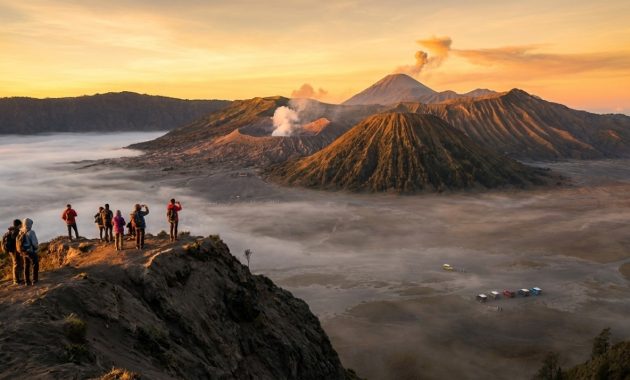
Indonesia sits on the Pacific Ring of Fire, home to more active volcanoes than any other country on Earth. From smoking craters and lunar landscapes to alpine rainforests and snow-capped peaks, Indonesia volcano travel offers experiences you simply won’t find anywhere else. Whether you are a first-time hiker chasing a sunrise above the clouds or an experienced mountaineer seeking multi-day expeditions, Indonesia’s volcanoes deliver challenge, beauty, and deep cultural meaning.
Volcano climbing in Indonesia is not just about altitude. It’s about walking through living geology, sacred landscapes, and remote communities that have adapted to the power of nature for centuries. This guide breaks down the best volcanoes and mountains to climb in Indonesia, complete with detailed route descriptions and realistic itineraries for the most popular multi-day treks.
Mount Bromo (Java) – The Most Accessible Volcano
Why Climb Mount Bromo
Mount Bromo is often considered the gateway to volcano travel in Indonesia. Located in East Java’s Tengger Caldera, it offers dramatic scenery without technical difficulty. You don’t climb for altitude here; you climb for atmosphere.
Route Breakdown
- Starting point: Cemoro Lawang village
- Elevation: 2,329 meters
- Climb duration: 30–45 minutes
- Trail type: Flat sand crossing + stair climb
The route begins with a walk across the Sea of Sand, followed by a concrete staircase leading to the crater rim. The sulfur smell and rumbling crater remind you that this is an active volcano.
Best For
- Beginners
- Sunrise photography
- Short trips
Mount Ijen (Java) – The Blue Fire Volcano
Why Climb Mount Ijen
Ijen is world-famous for its electric-blue flames and one of the most acidic crater lakes on Earth. This is one of the most unique volcano hikes in Indonesia.
Route Breakdown
- Starting point: Paltuding base camp
- Elevation: 2,386 meters
- Hiking time: 1.5–2 hours up
- Trail type: Wide dirt path, steady incline
The trail is well-maintained but exposed. Gas masks are mandatory near the crater due to sulfur fumes.
Best For
- Night hikes
- Unique geological phenomena
- Short but intense experiences
Mount Rinjani (Lombok) – Indonesia’s Most Iconic Trek
Why Climb Mount Rinjani
At 3,726 meters, Mount Rinjani is Indonesia’s second-highest volcano and one of Southeast Asia’s most spectacular treks. The crater lake, Segara Anak, and the active cone Gunung Barujari make this a bucket-list climb.
Route Breakdown
Route Options:
- Sembalun route (ascent)
- Senaru route (descent)
Key Stages:
- Sembalun village → Sembalun crater rim
- Crater rim → Segara Anak lake
- Lake → Summit attack
The summit push is infamous for loose volcanic scree, requiring stamina and mental resilience.
4-Day Rinjani Sample Itinerary
Day 1: Sembalun → Sembalun Crater Rim
- 6–7 hours hiking
- Camping above the clouds
Day 2: Crater Rim → Summit → Lake
- Midnight summit attempt
- Descent to Segara Anak
- Hot springs recovery
Day 3: Lake exploration
- Optional climb of Gunung Barujari
- Fishing and cultural storytelling
Day 4: Lake → Senaru village
- Long forest descent
Best For
- Experienced hikers
- Multi-day adventures
- Iconic Indonesian landscapes
Mount Semeru (Java) – The Sacred Giant
Why Climb Mount Semeru
Mount Semeru is Java’s highest peak and a sacred mountain in Hindu mythology. The constant eruptions of Jonggring Saloko crater add drama and danger.
Route Breakdown
- Starting point: Ranu Pane
- Elevation: 3,676 meters
- Trek length: 2–3 days
Key landmarks include Ranu Kumbolo lake and the steep volcanic sand summit cone.
3-Day Semeru Sample Itinerary
Day 1: Ranu Pane → Ranu Kumbolo
- Easy forest trek
- Lakeside camping
Day 2: Ranu Kumbolo → Kalimati
- Alpine grasslands
- Acclimatization
Day 3: Summit attack → descent
- Midnight start
- Strict timing due to eruptions
Best For
- Physically fit hikers
- High-altitude experience
Mount Kerinci (Sumatra) – The Highest Volcano in Indonesia
Why Climb Mount Kerinci
Mount Kerinci is Indonesia’s highest volcano and Sumatra’s tallest peak. Remote and demanding, it offers true expedition-style volcano travel.
Route Breakdown
- Starting point: Kersik Tuo village
- Elevation: 3,805 meters
- Duration: 2–3 days
The trail passes through dense rainforest filled with wildlife before opening into exposed volcanic terrain.
3-Day Kerinci Sample Itinerary
Day 1: Kersik Tuo → Shelter 2
- Jungle trekking
- High humidity
Day 2: Shelter 2 → Summit camp
- Steep ascent
- Cold conditions
Day 3: Summit push → descent
- Early morning summit
- Rapid weather changes
Best For
- Advanced hikers
- Remote experiences
Mount Agung (Bali) – The Sacred Peak
Why Climb Mount Agung
Mount Agung dominates Bali spiritually and physically. It is considered the dwelling place of the gods.
Route Breakdown
- Route 1: Pura Besakih (longer)
- Route 2: Pura Pasar Agung (shorter)
Summit climbs are steep, exposed, and often restricted due to volcanic activity.
Mount Batur (Bali) – The Sunrise Favorite
Why Climb Mount Batur
An easy sunrise hike with massive payoff, Mount Batur is perfect for beginners.
Route Breakdown
- Starting point: Toya Bungkah
- Duration: 2 hours up
- Trail: Volcanic rock paths
Puncak Jaya (Papua) – The Ultimate Climb
Height: 4,884 m
Also known as Carstensz Pyramid, Puncak Jaya is the highest mountain in Indonesia and one of the Seven Summits.
What Makes It Unique
- Alpine climbing techniques required
- Glacier remnants
- Complex logistics and permits
Other Notable Volcanoes & Mountains
- Mount Papandayan (West Java) – Easy trails and geothermal features
- Mount Merapi (Central Java) – Highly active and closely monitored
- Mount Tambora (Sumbawa) – Site of the largest volcanic eruption in recorded history
Best Time for Indonesia Volcano Travel
- Dry season: May–October (best)
- Wet season: November–April (muddy, risky)
High mountains may close during heavy rains.
Safety Tips for Volcano Climbing in Indonesia
- Always check volcanic status
- Hire licensed guides
- Carry gas masks where required
- Respect local spiritual rules
Packing List for Volcano Treks
- Hiking boots
- Warm layers
- Rain protection
- Headlamp
- Trekking poles
FAQs About Indonesia Volcano Travel
Is it safe to climb volcanoes in Indonesia?
Yes, when following official guidelines and closures.
Do I need a guide?
Some mountains require guides; others strongly recommend them.
Which volcano is best for beginners?
Mount Batur and Mount Bromo are ideal for beginners.
Which climb is the hardest?
Puncak Jaya and Mount Kerinci are the most challenging.
Can beginners climb Mount Rinjani?
Only with proper fitness and preparation.
Are permits required?
Yes, for most national parks and major mountains.
What is the best season to climb?
Dry season (April–October).
Are volcanoes open year-round?
Closures depend on weather and volcanic activity.
Can I climb without hiking experience?
Yes, on easy routes with guides.
How cold does it get?
Temperatures can drop below 5°C at higher elevations.
Is altitude sickness common?
Possible on higher peaks like Kerinci and Puncak Jaya.
Are sunrise hikes worth it?
Absolutely—sunrise is the highlight of most climbs.
Final Verdict: Why Volcano Climbing Defines Indonesia Travel
Indonesia volcano travel is not just an activity; it’s a journey into the heart of the archipelago. From beginner-friendly sunrises to demanding summit expeditions, these mountains define Indonesia’s wild beauty and spiritual depth. If you want adventure that feels raw, meaningful, and unforgettable, Indonesia’s volcanoes are waiting.